
In Spain, any power generation facility of ≥1 MW must integrate an RTU or Gateway running the IEC 60870–5‑104 protocol to inject and trade energy on the grid.
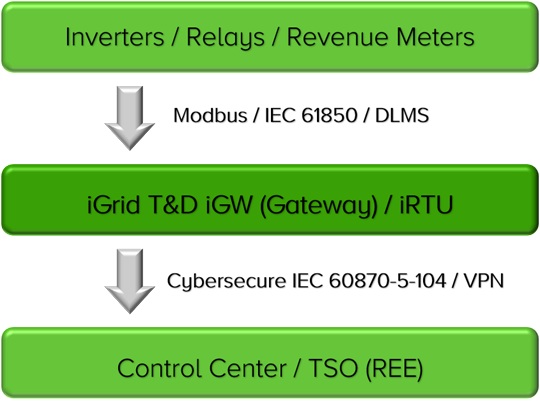
Grid regulations require real-time telemetry transmission and active remote control capability by the Transmission System Operator (Red Eléctrica de España — REE). Because field equipment (inverters, relays, meters) communicates via disparate local protocols such as Modbus or DLMS, a cybersecure RTU/Gateway serves as the critical bridge that translates local metrology into the IEC-104 standard required by Control Centers.
What Is the IEC 60870–5‑104 Protocol and Why Is It the Grid Standard?
The IEC 60870–5‑104 (IEC-104) protocol is part of the international standards developed by the International Electrotechnical Commission for power system automation and telecontrol (Grid Automation).
Unlike legacy industrial protocols, IEC-104 provides four critical operational advantages:
- Native TCP/IP Communication: Designed for long-distance data transmission over Ethernet, fiber optics, and 4G/5G links using secure VPN tunnels.
- Event-Driven Transmission and High-Precision Timestamping: Instead of continuous polling that saturates bandwidth, the protocol reports state changes or anomalies at the millisecond level, enabling precise post-fault forensic analysis.
- Bidirectional Telecontrol via Select Before Operate (SBO): A dual-confirmation safety mechanism that validates a command before execution, preventing unintended switching during remote power setpoint adjustments.
- IEC 62351 Cybersecurity Compliance: Native integration of encryption and authentication layers necessary to protect critical energy infrastructure.
The Regulatory Framework: From Legislation to Technical Specifications
The requirement for the IEC-104 protocol in medium and utility-scale power plants is not a discretionary decision by the Control Center, but the direct result of a strict regulatory chain in Spain:
- Royal Decree (RD) 413/2014 (Art. 7.c): Establishes the legal obligation to send real-time telemetry for all power generation facilities ≥1 MW.
- Annex II of RD 413/2014: Mandates that integration must comply with the technical specifications and Operating Procedures of the electrical system.
- Operating Procedure 9.2 (P.O. 9.2): Defines the scope of data exchange with REE and regulates the requirements for binding to an Authorized Generation and Distribution Control Center (CCGD).
- REE Technical Specifications: Establish the IEC 60870–5‑104 protocol as the official standard for data exchange and delegated dispatch.
Practical Nuance for the 1 MW to 5 MW Range:
Historically, facilities between 1 MW and 5 MW operated with certain flexibility regarding passive telemetry reporting. However, the operational evolution of P.O. 9.2 and the need for grid stability during oversupply events or voltage sags have unified criteria: today, the required technical solution for grid market participation demands active regulation via delegated dispatch under the IEC-104 protocol.
What Does the System Operator Protect Through This Requirement?
REE’s mandate addresses fundamental physics and industrial safety concerns:
Over frequency Control (Blackout Prevention): When renewable generation significantly exceeds demand, the grid frequency (50 Hz) rises. Without remote curtailment capability, the system risks cascading outages.
Local Technical Constraint Management: Detecting capacity bottlenecks on specific distribution lines and applying selective power reductions before protection trips occur.
Voltage Stability (Reactive Power Control): Managing reactive power injection or absorption at the Point of Interconnection (POI) to maintain voltage within regulatory limits.
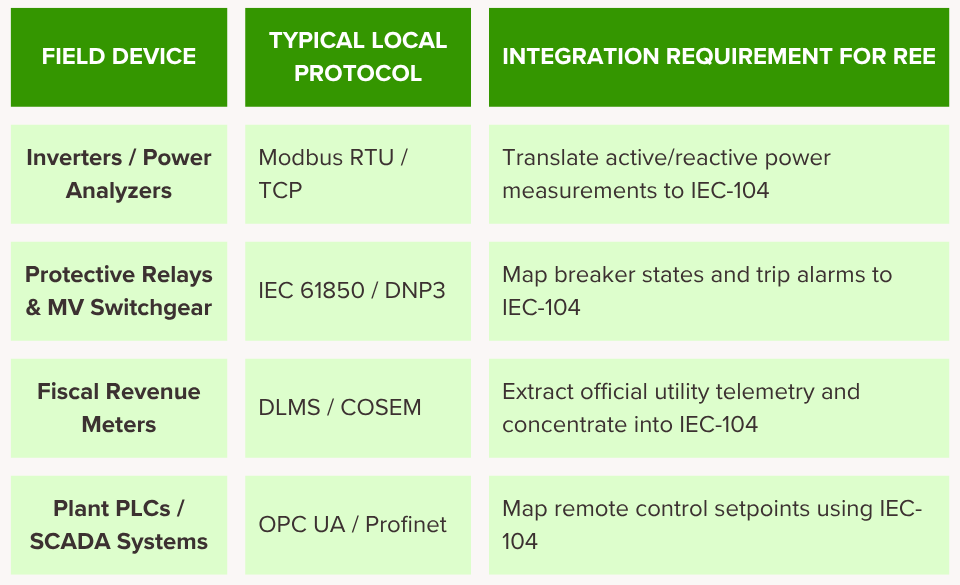
On-Site Challenge: Heterogeneous Field Protocols vs. Grid Standards
The primary challenge for engineering firms and developers lies in the coexistence of multiple industrial communication protocols within the same control cabinet:
The Technical Solution: Cybersecure Multiprotocol RTUs and Gateways
To bridge the gap between plant-level diversity and grid-level compliance, the facility requires a Remote Terminal Unit (RTU) or Communications Gateway.
This device performs three simultaneous tasks:
1. Local Multiprotocol Data Ingestion: Maintains active serial or Ethernet links with field equipment.
2. Data Normalization: Maps local register addresses to the memory structure required by P.O. 9.2.
3. IEC 60870–5‑104 Server: Maintains an encrypted VPN tunnel to the Control Center, transmitting telemetry and executing control setpoints within milliseconds.
Simplified Integration with iGrid T&D’s iGW Series
At iGrid T&D, we design and manufacture specialized solutions for grid automation and remote management. Our iGWs and iRTUs streamline the integration of renewable assets under the highest market standards:
• Native Multiprotocol Conversion: Concentrates data from Modbus, IEC 61850, DLMS, or DNP3 directly into IEC 60870–5‑104 without extra controllers.
• DIN-Rail Industrial Hardware: Compact, low-power hardware featuring high electromagnetic compatibility (EMC) immunity and extended operating temperature ranges.
• Cybersecurity by Design: Engineered for critical IP networks using IPsec/OpenVPN tunnels and security profiles aligned with IEC 62351.
Frequently Asked Questions (FAQ) on IEC-104 Compliance in Renewable Plants
Can a 1.5 MW solar plant send Modbus telemetry directly to a Control Center?
No. The System Operator (REE) and Authorized Control Centers do not accept direct Modbus connections for delegated dispatch. External communications must strictly use the IEC 60870–5‑104 protocol.
What happens if the RTU loses its IEC-104 link to the Control Center?
A prolonged communication loss can trigger automated curtailment orders or temporary grid disconnection under P.O. 9.2 rules. This is why deployable Gateways and RTUs must be certified for harsh grid environments. To eliminate single points of failure, iGrid T&D’s iGW and iRTU series include built-in hardware redundancy—such as dual-homing IEC-104 channels, redundant Ethernet ports, and cellular failover (4G/5G)—ensuring continuous telemetry and preventing unexpected downtime.
Can the same RTU send data to REE and the owner’s Cloud platform simultaneously?
Yes. Certified Gateways like the iGW series support independent, multi-destination data processing. They transmit real-time telemetry to the Control Center via IEC-104 for regulatory compliance, while concurrently streaming operational metrics to Cloud monitoring platforms using IIoT protocols like MQTT or HTTP REST APIs without affecting grid communications
The Cost of Non-Compliance: Operational & Financial Risks
In today’s evolving power system, compliance with P.O. 9.2 regulations and the IEC 60870–5‑104 standard is not an optional feature—it is a strict legal and technical requirement for grid operation.
Operating a power plant without dedicated telecontrol hardware and reliable protocol translation introduces critical vulnerabilities:
- Temporary or Permanent Grid Disconnection: The Transmission System Operator (REE) can restrict or suspend market access if active real-time observability and remote regulation are not guaranteed.
- Revenue Loss from Forced Curtailment: Failing to respond within milliseconds to remote active or reactive power setpoints leads to unbilled generation hours and severe market penalties.
- Cybersecurity Breaches and System Instability: Relying on generic converters or software patches exposes critical infrastructure to cyber threats and unexpected communication outages.
Equipping your generation facility with purpose-built RTUs and Gateways goes beyond fulfilling a regulatory mandate—it is the ultimate assurance to safeguard plant availability, protect your capital assets, and guarantee long-term project profitability.
Need to Adapt Your Generation Asset to P.O. 9.2 Requirements?
We specialize in power grid automation and telecontrol solutions.
👉 Consult with our engineering team at iGrid T&D to evaluate the optimal communications architecture for your project [email protected].